
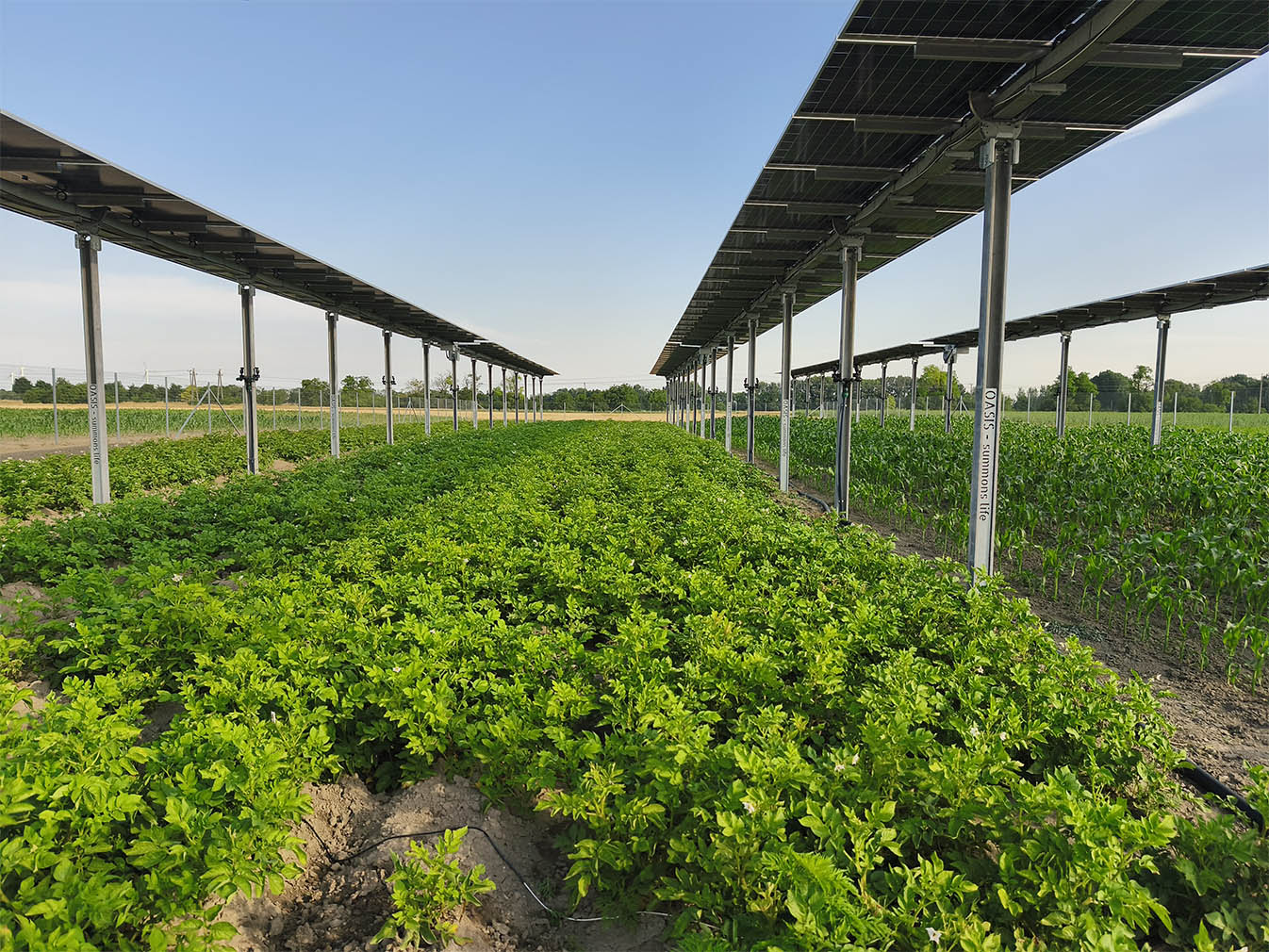
OASIS: an agrisolar innovation that generates electricity whilst supporting sustainable crop production
What is OASIS?
The rapid expansion of solar farms worldwide plays a key role in the production of cleaner energy; however, they are often criticised for taking valuable agricultural land out of cultivation. Our innovative agro-energy concept offers a solution to this challenge: OASIS, which combines electricity generation and crop production on the same land, whilst supporting more efficient farming through irrigation and smart farming solutions.
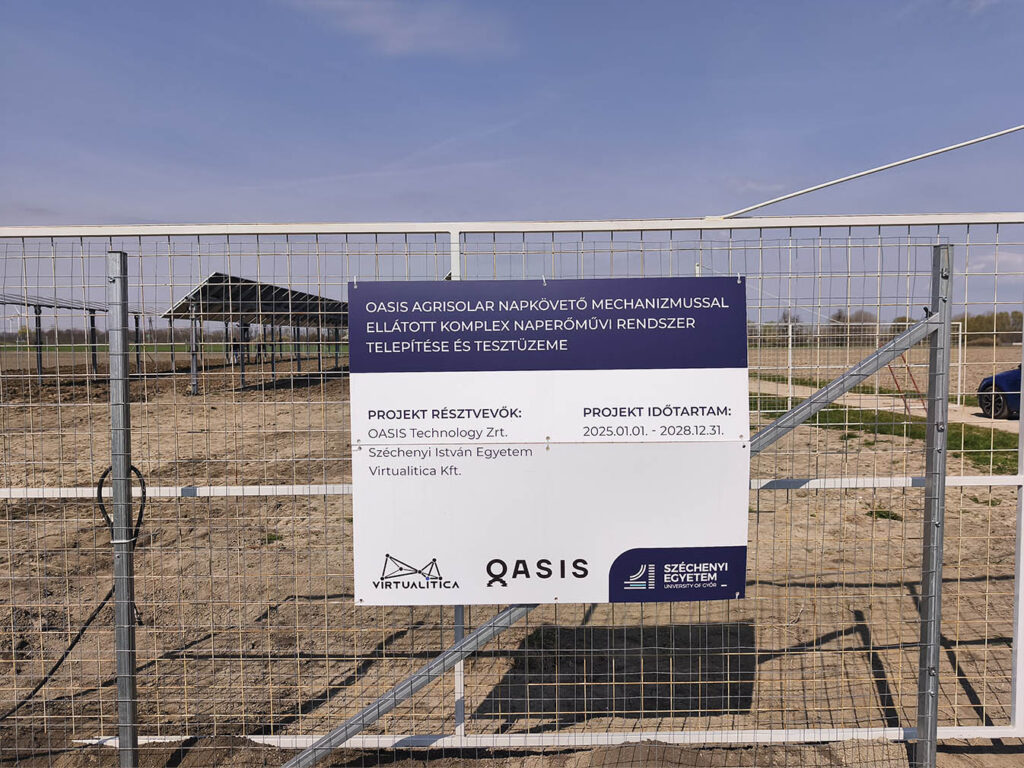
The OASIS project was implemented by Renergy Szolgáltató Zrt. (investor and concept developer) and Virtualitica Kft. (technical developer) in collaboration with the Albert Kázmér Faculty of Széchenyi István University in Mosonmagyaróvár. The essence of the concept is that the installation of photovoltaic systems should not ‘displace’ but rather complement agricultural production.
Irrigation and Shading (not necessarily a disadvantage – quite the contrary)
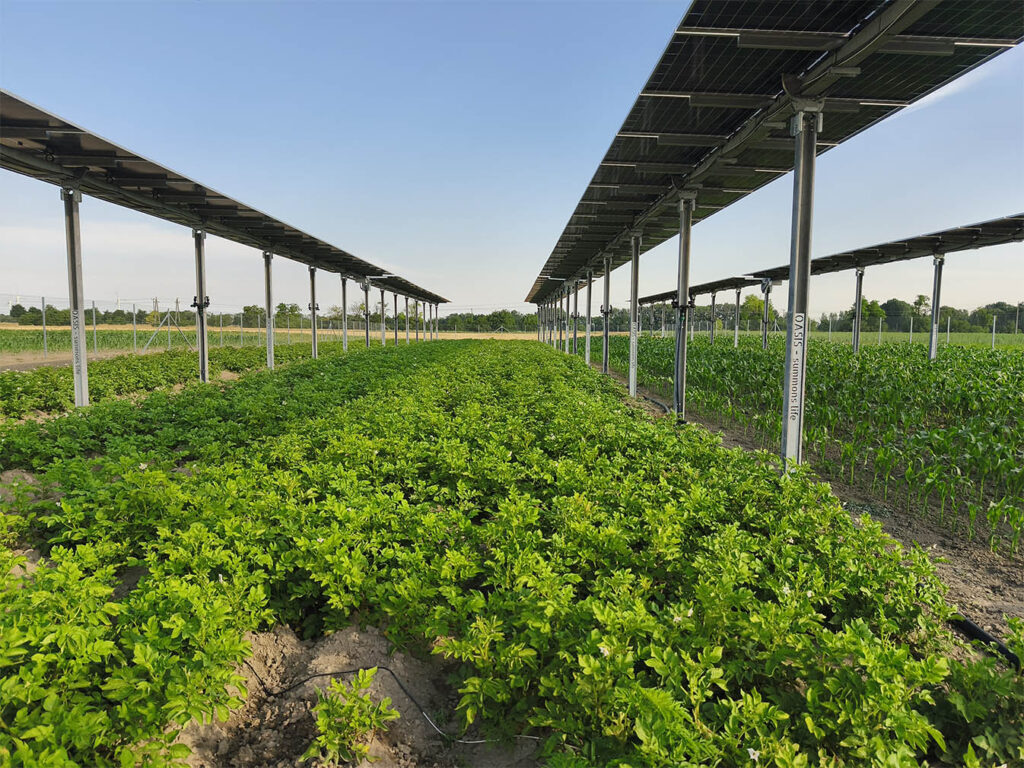
At first glance, one might ask: does the shade cast by the solar panels placed above the crops reduce photosynthesis and, consequently, crop yield? Based on international agrisolar trials and experience – provided that appropriate row spacing, panel size and control systems are in place – in many cases there is no reduction; indeed, under certain conditions, the plants’ microclimate actually improves. Several of our own, unique developments are also linked to the project. One such innovation is the specially designed combined solar panel mount, which, via irrigation nozzles fitted to it, enables the system to irrigate the plants situated beneath it. A further advantage of OASIS is that the evaporation resulting from irrigation cools the photovoltaic cells, which can have a positive effect on energy production efficiency. Another innovation is the university’s in-house meteorological station, which collects environmental data to assist in controlling the panels and the irrigation system
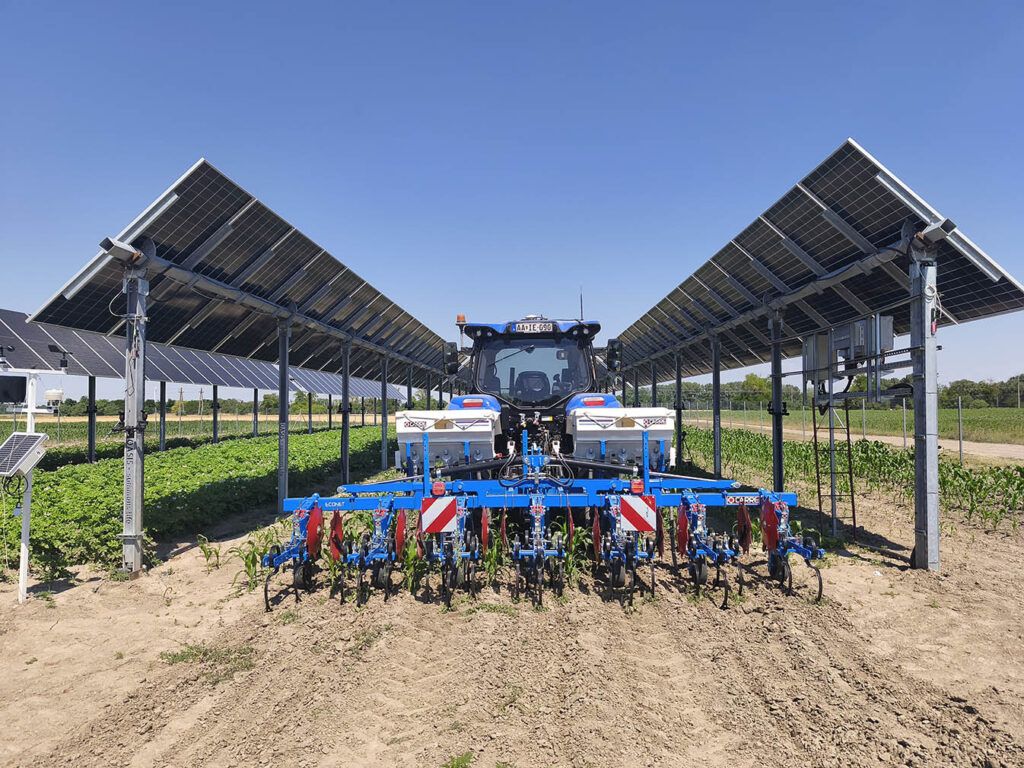
Prototype Park in Mosonmagyaróvár: a market-ready solution based on real-world experience
Our partners, researchers from Széchenyi István University, have supported the project by selecting the most suitable crop varieties, refining the irrigation concept, establishing occupational safety regulations, and implementing data- and sensor-driven monitoring of the plants’ life cycles. This approach also provides valuable data for the development of precision farming systems.
Crop production linked to irrigation began in the spring of 2026; in the first year, maize and potatoes were grown beneath the solar panels.
Addressing Desertification and the Challenges of Rural Quality of Life
Desertification and the degradation of arable land are increasingly serious problems in more and more regions of the world – including certain parts of Hungary. Our long-term vision goes beyond a solar power system capable of providing irrigation: the aim is to create a self-sustaining ecosystem that can prevent or help reverse land degradation, create jobs, and measurably improve the local quality of life.
There is significant interest in the concept in both African and Asian markets, where energy supply is a critical issue alongside the challenges of the food supply chain. In addition to meeting agricultural needs, OASIS also generates surplus electricity, which supports the energy supply for processing plants, community facilities and residential communities linked to the park. The combined presence of production and processing can also help to create local communities and jobs.
